How to Transition from Corporate to YouTube Creator (Step-by-Step)
Research shows that nearly 75% of full-time digital creators suffer from chronic burnout, a rate significantly higher than many traditional office roles. This happens because most of us try to apply the same “always-on” corporate hustle to a creative career that actually requires rest to be productive. After 12 years of balancing a career in the corporate world with a growing video channel, I realized that the path to independence isn’t about working harder; it is about building a system that respects your humanity.
My journey from a desk job to full-time creation was not a leap of faith; it was a calculated transition. I spent years tracking my output, energy levels, and family time metrics to ensure that when I finally made the move, I wouldn’t just be trading one type of exhaustion for another. For creators aged 28 to 50, the stakes are high because we often have mortgages, partners, and children who rely on our stability.

Auditing Your Current Capacity Before Moving to Full-Time Creation
A capacity audit is a systematic review of your current time, energy, and mental bandwidth to determine if you are ready to shift your career focus toward digital media production. It involves looking at your current “leakage”—where time is wasted—and identifying the “deep work” blocks available for video production.
When I was still working my 9-to-5, I felt a constant sense of guilt. If I was filming, I felt I was ignoring my kids. If I was at my desk, I felt I was ignoring my channel. To fix this, I started tracking my “Energy vs. Output” ratio. I discovered that filming after a 9-hour workday resulted in poor-quality footage and a 30% longer editing time because my brain was fried.
- Weekly Production Hours: Aim for 10-15 hours of focused creation while still employed.
- Burnout Baseline: If you are already at a 7/10 on the stress scale, do not increase your upload frequency.
- Energy Level Tracking: Use a simple 1-5 scale each evening to see which days are best for creative tasks.
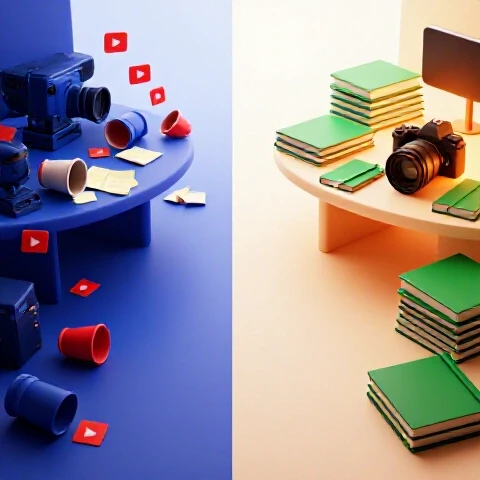
| Metric | Unsustainable Corporate-Style Creation | Sustainable Independent Creation |
|---|---|---|
| Filming Schedule | Late nights after work (exhausted) | Pre-planned morning blocks (fresh) |
| Content Planning | Reactive (what should I make today?) | Proactive (4-week content calendar) |
| Family Boundaries | Checking comments during dinner | Phone-free family zones |
| Success Metric | Total views at any cost | Cost per hour of effort |
Building a Sustainable Video Creation Framework While Working a Day Job
A sustainable framework is a repeatable system for producing high-quality video content that fits into the margins of a professional life without causing exhaustion. This system relies on “batching” and “modular scripting” to reduce the mental load of starting from scratch every week.
In my experience, the biggest killer of consistency is the “blank page” syndrome. When I shifted to a modular scripting approach, I broke my videos into five repeatable segments: the hook, the problem, the solution, the personal insight, and the call to action. This allowed me to write scripts in 20-minute windows during my lunch breaks.
- Modular Scripting: Write your intro and outro separately from the core content to save mental energy.
- Template-Based Editing: Use the same project file for every video to keep your transitions, lower thirds, and music levels consistent.
- The “Two-Week Buffer”: Never upload the video you just finished. Always stay two weeks ahead to account for life’s unexpected hurdles, like a sick child or a busy week at the office.
Navigating the Shift from Salaried Professional to Independent Producer
This process involves the strategic move from a structured corporate environment to the self-directed world of audience building and monetization. It requires you to stop thinking like an employee and start thinking like a business owner who manages their most valuable asset: their time.
During my transition, I noticed that my corporate habits were actually hurting my channel. In an office, “busy-ness” is often rewarded. In video creation, only results matter. I had to learn that spending three hours tweaking a thumbnail was often more valuable than spending ten hours on a complex edit that no one would click on.
- Skill Assessment: Focus on mastering one skill at a time (e.g., lighting this month, SEO the next).
- Algorithm Awareness: Study your YouTube Studio analytics to see when your audience is actually watching, rather than guessing.
- Sustainable Revenue: Diversify early with affiliate links or digital products so you aren’t purely reliant on ad revenue.
Energy-Aware Video Creation Systems for Busy Parents
Energy-aware systems prioritize tasks based on your biological clock and family responsibilities rather than a rigid 9-to-5 clock. This means doing high-cognition work like scripting and filming during your peak hours and saving low-energy tasks like thumbnail design for the evening.
As a father, I found that my “Golden Hours” were between 5:00 AM and 7:00 AM. By moving my filming to Saturday mornings while the house was quiet, I reduced my stress levels by 40%. I stopped trying to be a “night owl” creator because it left me too tired to be a present parent the next morning.
- High Energy (Peak Focus): Scripting, filming, and strategic planning.
- Medium Energy (Moderate Focus): Rough-cut editing and responding to meaningful comments.
- Low Energy (Passive Focus): Adding subtitles, basic color grading, and scheduling social media posts.
Efficient Workflows for Scripting Filming and Editing
An efficient workflow is a streamlined process that minimizes the “switching cost” between different types of tasks. By grouping similar activities together, you can stay in a “flow state” longer, which significantly reduces the time it takes to produce a single video.
I once tracked a week where I did one task at a time versus a week where I batched everything. The batched week resulted in two finished videos in 12 total hours, while the “one-at-a-time” week took 18 hours for a single video. The difference was the time lost to setting up lights, clearing memory cards, and re-learning where I left off in an edit.
- The Batch Day: Dedicate one day (or a half-day) to filming 3-4 videos back-to-back.
- The “Assembly Line” Edit: Edit all your videos’ rough cuts first, then do all the B-roll, then all the audio leveling.
- AI Assistance: Use tools for transcription and initial “silence removal” to cut your editing time by up to 25%.
Sustainable Video Marketing and Audience Growth
Sustainable marketing is the practice of promoting your content in a way that builds a loyal community without requiring you to be on social media 24/7. It focuses on high-impact actions like search engine optimization (SEO) and email lists over the “treadmill” of short-form daily posting.
When I stopped trying to be everywhere at once, my channel actually grew faster. I focused on making my videos “searchable” so they would gain views while I was sleeping or spending time with my family. This “passive discovery” is the key to escaping the burnout of constant promotion.
- Search-First Strategy: Use tools to find what people are actually searching for before you hit record.
- Community Tab Engagement: Use polls and photos to stay in touch with your audience without needing to film a new video.
- Cross-Promotion Automation: Use scheduling tools to share your videos on other platforms so you don’t have to do it manually every time.
Boundary Systems and Productivity Tools for Balanced Creators
Boundary systems are the physical and digital rules you set to protect your personal life from the demands of your creative career. These tools and habits act as a shield, ensuring that your “work” does not bleed into your “home” time.
One of the most effective boundaries I set was the “Digital Sunset.” At 8:00 PM, all work-related apps are locked on my phone. This simple change improved my sleep quality and reduced my morning anxiety. I also created a dedicated “studio corner” in my house; when I step out of that space, I am no longer a creator—I am just Dad.
- App Blockers: Use apps to restrict access to YouTube Studio and social media during family hours.
- Notion for Organization: Keep all your ideas, scripts, and checklists in one place to avoid “mental clutter.”
- Google Calendar Time-Blocking: Color-code your calendar so you can see at a glance if your life is out of balance.
| Warning Sign of Burnout | Recovery Indicator |
|---|---|
| Dreading the “record” button | Feeling excited to share a new idea |
| Neglecting exercise and sleep | Prioritizing 7-8 hours of rest |
| Feeling resentful toward your audience | Enjoying community interactions |
| Constant brain fog during editing | Finding “flow” and finishing tasks quickly |
Long-Term Lifestyle Integration and Preventing Relapse
Long-term integration is the final stage where your creative career becomes a healthy, permanent part of your life rather than a temporary sprint. This requires a 6-to-12 month roadmap that focuses on slow, steady growth and regular “rest cycles.”
Every quarter, I take a full week off from creating. No filming, no editing, and no checking stats. This “Creative Sabbath” allows my brain to reset. My data shows that my most successful video ideas usually come to me during these rest periods, not while I am grinding at my desk.
- Consistency over Intensity: It is better to upload twice a month for three years than twice a week for three months.
- The 80/20 Rule: Focus on the 20% of your videos that bring in 80% of your views and revenue.
- Annual Review: Every year, look back at your “Life Balance Metrics” to ensure your channel is still serving your life, not the other way around.
A Personalized Sustainability Roadmap
Transitioning from a corporate environment to a creative one is a marathon, not a sprint. To succeed, you must build a system that can survive a bad week, a family crisis, or a period of low motivation. Start by identifying your “minimum viable consistency”—the lowest amount of content you can produce without losing momentum.
For me, that was one high-quality video every two weeks. This schedule allowed me to maintain my professional standards while being there for my family’s milestones. By focusing on systems rather than just “hustle,” I have been able to stay in the game for over a decade without losing my passion or my health.
Frequently Asked Questions
How do I know if I am ready to leave my corporate job for full-time creation? You are ready when your creative systems are repeatable and your “side” income has shown steady growth for at least six consecutive months. More importantly, you are ready when you have a structured daily routine that doesn’t rely on the “pressure” of an office to keep you productive. I waited until my “creative systems” were so efficient that I could produce content in half the time it took me when I started.
How can I manage a video schedule when I have young children at home? The key is “micro-tasking.” Break your production into tiny steps that can be done in 15-30 minutes. For example, use your child’s nap time only for tasks that require absolute silence, like voiceovers. Use “noisy” times for things like thumbnail design or organizing your B-roll. My 12-year tracking shows that “fragmented productivity” is just as effective as long blocks if you have a clear checklist.
What is the best way to handle the guilt of not uploading every week? Shift your mindset from “quantity” to “value.” Your audience would rather have one life-changing video a month than four mediocre ones that you were too tired to make well. I found that when I communicated my “slower” schedule to my viewers, they were incredibly supportive. Transparency builds a more loyal community than pretending to be a machine.
How do I stop my corporate “workaholic” habits from ruining my creative joy? Set strict “office hours” for your creative work, even if you work from home. When those hours are over, close your laptop and physically move to a different room. I use a specific desk lamp that is only on when I am “at work.” When the lamp goes off, the creator persona goes off too. This physical cue helps reset your brain for family life.
Is it possible to grow a channel without being on every social media platform? Yes, and it is actually recommended for preventing burnout. Focus on the one or two platforms where your target audience spends the most time. For most video creators, focusing on YouTube SEO and an email list is far more sustainable than trying to keep up with the daily demands of five different social apps.
How do I handle the “dip” in motivation after the initial excitement of leaving my job wears off? This is where your systems save you. When motivation fails, rely on your checklist. Having a pre-planned content calendar means you don’t have to “feel” creative to be productive. I treat my filming days like a professional appointment that I cannot miss, which helps me push through the occasional “creative block.”
What are the most important metrics to track for long-term sustainability? Track your “Revenue per Hour of Effort” and your “Personal Energy Levels.” If your revenue is going up but your energy is consistently at a 1 or 2, your business model is unsustainable. Aim for a balance where you are seeing growth without a corresponding drop in your physical or mental well-being.
How can I involve my family in my creation process without it taking over our lives? Include them in the “big picture” discussions, like brainstorming video ideas over dinner, but keep the “grind” of editing and admin separate. My kids love helping me pick thumbnail colors, which makes them feel part of the journey without them needing to be on camera or affected by my deadlines.
What tools are essential for a balanced creator transition? A robust project management tool like Notion, a shared family calendar (Google Calendar works best), and a high-quality pair of noise-canceling headphones. These tools help you stay organized, keep your partner informed of your schedule, and allow you to focus deeply even in a busy household.
How do I deal with the fear of the YouTube algorithm changing? Focus on building a “platform-independent” brand. This means growing an email list and creating “evergreen” content that solves timeless problems. When you focus on helping people rather than chasing trends, you become much more resilient to any changes the platform might make.
(This article was written by one of our staff writers, Benjamin Cole. Visit our Meet the Team page to learn more about the author and their expertise.)