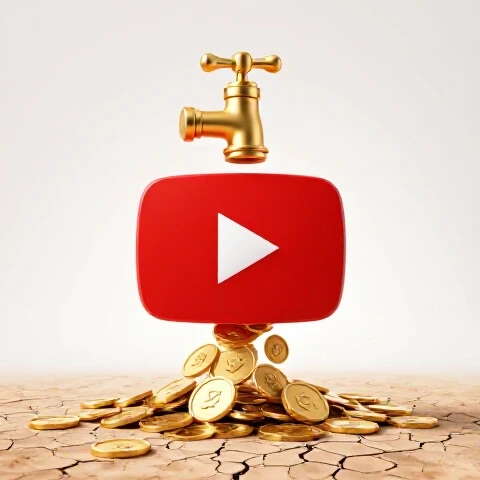
Understanding YouTube CPM Seasonality: What Creators Should Know (Guide)
Imagine waking up on January 1st. You check your analytics, expecting to see the same momentum you had in December. Instead, you see a cliff. Your views are steady, but your earnings have plummeted by forty percent overnight. For a casual hobbyist, this is a curiosity. For someone trying to pay a mortgage with their content, it is a crisis. Over the last decade, I have managed multiple channels and seen this pattern repeat every single year. It is not a glitch in the system; it is the heartbeat of the advertising world.
The problem most creators face is a lack of financial systems to handle these waves. They rely on the “hope and pray” method of monetization. They hope the views stay high and pray the ad rates do not drop. But the market does not care about your hopes. Advertisers spend money based on consumer behavior and corporate budget cycles. If you want to turn your channel into a predictable business, you must stop being a victim of these cycles and start planning for them.

Understanding the Annual Cycle of Advertiser Spending
The ad market moves in predictable waves based on when companies want to sell their products and when they need to clear their budgets.
In the world of online video, the amount you earn per thousand views is not a flat rate. It is a shifting number driven by supply and demand. In the first quarter of the year, companies are often setting new budgets and consumers are recovering from holiday spending. As a result, the demand for ad space drops, and so does your income. By the fourth quarter, the opposite happens. Brands are desperate to reach holiday shoppers, and they have “use it or lose it” budgets to spend before the year ends.
I have found that tracking these shifts is the first step toward financial stability. You cannot control what advertisers pay, but you can control how you react to it. Understanding that a dip in January is normal allows you to keep your cool. It gives you the space to focus on long-term growth rather than panic-editing your next video.
| Quarter | Advertiser Behavior | Typical Ad Rate Impact | Creator Strategy |
|---|---|---|---|
| Q1 (Jan-Mar) | Budget resetting; low consumer spending | Significant Decrease (30-50%) | Focus on evergreen content and SEO |
| Q2 (Apr-Jun) | Spring campaigns; mid-year pushes | Moderate Increase | Launch new series or format tests |
| Q3 (Jul-Sep) | Back-to-school; summer lull then ramp-up | Stable to Rising | Build audience for the Q4 surge |
| Q4 (Oct-Dec) | Holiday shopping; budget clearing | Peak Levels (Highest of year) | High-frequency posting; product launches |
Auditing Your Financial Reality Through Ad Rate Fluctuations
A professional creator treats their channel like a business by maintaining clear ledgers that account for both income and the hidden costs of production.
Most creators only look at their “Estimated Revenue” tab. This is a mistake. To build a sustainable business, you need to track your “take-home” pay after expenses. I have seen creators who make a lot of money on paper but are actually losing money because their production costs are too high during low-earning months. You need a simple system to track every dollar that goes out—from software subscriptions to the coffee you bought for a guest.
When you track your expenses against your fluctuating income, you find your “break-even” point. This is the minimum amount you need to earn each month to keep the lights on. Knowing this number changes everything. It tells you when you can afford to invest in a new camera and when you need to cut back on freelance editors.
How to Track Hidden Production Costs and Build a Profitable Budget
- Categorize Every Expense: Divide your costs into “Fixed” (subscriptions, rent) and “Variable” (gear, freelance help, travel).
- Calculate Cost Per Video: Total your monthly expenses and divide by the number of videos you produced.
- Monitor Your Profit Margin: Subtract your cost per video from the revenue that video generated.
- Create a “Dry Season” Reserve: Save a percentage of your peak Q4 earnings to cover your expenses during the Q1 dip.
Strategic Video Creation for Peak Earning Periods
Not all views are created equal, and timing your highest-value content to match high-spending months can significantly boost your annual bottom line.
If you know that advertisers are willing to pay three times more for a view in November than in January, it makes sense to save your most “shoppable” content for the end of the year. I call this revenue-focused video creation. During the high-rate months, focus on topics that lead to purchases. These are “Best of” lists, gift guides, and deep-dive reviews. Advertisers love these videos because the viewers are already in a buying mindset.
In the low-rate months, I shift my strategy toward data-driven video marketing that focuses on reach and retention. January is a great time for “How-to” guides, educational content, or “Year Ahead” predictions. These videos might not earn as much per view, but they build your subscriber base and keep your channel healthy for the next high-value window.
- High-Value Windows (Q4): Focus on “Buying Intent” keywords.
- Low-Value Windows (Q1): Focus on “Search Intent” and “Educational” keywords.
- Bridge Periods (Q2-Q3): Test new formats and build community engagement.
Diversifying Income to Neutralize Revenue Volatility
The most dangerous number in any business is “one.” If you rely on one source of income, like ad revenue, you are at the mercy of a system you don’t control.
To transition from a hobbyist to a pro, you must diversify YouTube income. I aim for a revenue mix where ad revenue makes up no more than 50% of my total earnings. The rest should come from sources that are more stable, such as affiliate marketing, digital products, or memberships. These streams often have their own cycles, but they rarely crash at the exact same time as ad rates.
For example, affiliate income for home office gear might spike in January when people are setting New Year’s resolutions to be more productive. This can perfectly offset the drop in ad revenue. By building a “three-legged stool” of income—ads, affiliates, and your own products—you create a financial floor that keeps you safe.
| Revenue Stream | Stability Level | Best Month to Focus | Why It Works |
|---|---|---|---|
| AdSense | Low (Volatile) | November/December | High advertiser competition |
| Affiliates | Medium | January/November | Resolutions and Holiday sales |
| Digital Products | High | September/January | Back-to-school and New Year starts |
| Memberships | Very High | Consistent | Recurring monthly support |
Sponsorship Negotiation Strategies for Every Season
Negotiating fair rates requires you to understand your value beyond just the current ad market rates.
Many creators feel powerless when negotiating sponsorships during the “slow” months. They see their ad revenue dropping and assume they should lower their sponsorship rates too. This is a trap. A brand deal is a direct partnership, not an automated auction. Your value to a brand is based on your relationship with your audience and the quality of your work, neither of which changes just because it is January.
In my experience, the best way to handle this is to use a sponsorship negotiation guide based on long-term data. Instead of quoting a price based on your last thirty days of views, quote based on your six-month average. This smooths out the peaks and valleys. I also recommend pitching “multi-video bundles” that span across different quarters. This secures your income for months in advance and gives the brand a better result through repeated exposure.
- Step 1: Track your average views over a 180-day period.
- Step 2: Create a “Media Kit” that highlights your audience demographics, not just view counts.
- Step 3: Offer “Value-Adds” like community post shoutouts or newsletter inclusions to maintain your price floor.
- Step 4: Propose long-term partnerships (3-6 months) to stabilize your monthly cash flow.
Building a Long-Term Profitability System
Sustainable growth comes from having a plan that looks 12 to 24 months into the future rather than just looking at next week’s upload.
A YouTube profitability timeline is rarely a straight line up. It looks more like a staircase. You grow, you plateau, you learn, and then you grow again. To stay in the game for ten years like I have, you need to manage your mental energy as much as your money. Financial stress is the number one cause of creator burnout. When you don’t know where your next check is coming from, every video feels like a life-or-death struggle.
By implementing a financial dashboard, you can see the big picture. I use a simple Google Sheet to track my monthly “Gross Revenue” vs. “Net Profit.” This helps me see that even if my revenue is down in February, my profit might be up because I spent less on production. This clarity is what allows you to make calm, data-driven decisions for your business.
Essential Tools for Financial Tracking
- YouTube Analytics (Revenue Tab): Use the “Advanced Mode” to compare year-over-year performance for specific months.
- Google Sheets/Excel: Create a master ledger for all income sources and every single expense.
- Notion Financial Dashboard: Use this to track sponsorship pipelines and upcoming payment due dates.
- Sponsorship CRM: A simple tool to keep track of brand contacts and previous deal terms.
- Affiliate Dashboards: Regularly check which products are converting best to inform your future content.
Establishing a Realistic Roadmap for Growth
Transitioning from a casual creator to a business owner takes time. You should not expect to have a perfectly diversified income stream in three months.
In the first six months of monetization, your goal should be purely about understanding your data. Don’t worry about the dips; just record them. In months six through twelve, start testing one new revenue stream, like a specific affiliate program. By the second year, you should have enough data to predict your “lean months” and have a plan to fill those gaps with sponsorships or product launches.
This measured approach reduces the financial uncertainty that plagues most creators. You stop being a gambler and start being an operator. You recognize that the “January Slump” is just an opportunity to work on your systems, and the “December Peak” is a time to bank your profits for the future.
- Months 1-6: Focus on consistent production and expense tracking.
- Months 7-12: Identify your highest-performing content and find related affiliate products.
- Months 13-24: Build out a sponsorship kit and pitch long-term deals to stabilize monthly income.
Frequently Asked Questions
Why does my revenue drop so much in January even if my views stay the same? This happens because of the way the ad auction works. In December, many brands compete for ad space, which drives prices up. In January, brands reset their budgets and consumers spend less. With fewer brands bidding, the “price” for your views drops. It is a market-wide shift, not a reflection of your content quality.
How much should I save from my “good” months to survive the “bad” months? A good rule of thumb is to set aside 20% of your gross income during peak months (like November and December). This creates a “buffer fund” that can supplement your income during the lower-earning months of the first quarter.
Is it better to post more or less during low-rate months? I recommend maintaining your schedule but changing your content type. Instead of high-cost, high-effort videos that require a large return to break even, focus on evergreen content. These are videos that will continue to get views for years. This way, you are building long-term value even when the immediate payout is lower.
What is a “good” RPM for a creator? RPM (Revenue Per Mille) varies wildly by niche. A finance or business channel might see an RPM of $15 to $30, while a gaming or lifestyle channel might see $2 to $5. The key is not to compare yourself to others, but to compare your own January RPM to your own December RPM to understand your channel’s specific volatility.
Should I lower my sponsorship rates in the summer or winter? No. Your sponsorship rate should be based on the value you provide to the brand, which includes your influence, your production quality, and your audience’s trust. These things do not fluctuate with the ad market. Stick to your base rate and offer more “deliverables” (like extra social posts) if you need to sweeten the deal for a brand with a tight budget.
How do I calculate my channel’s break-even point? Add up all your monthly business expenses (software, gear, help, internet). Divide that total by your average RPM. This will tell you exactly how many thousands of views you need every month just to cover your costs. Knowing this number helps you decide if you can afford to go full-time.
What is the fastest way to diversify my income? Affiliate marketing is often the fastest. You can add links to products you already use in your video descriptions today. It requires no upfront cost and no minimum follower count. Pick products that truly help your audience, and you will see a steady climb in non-ad revenue.
How often should I audit my expenses? I do a “deep dive” once every quarter. I look for subscriptions I no longer use and check if my “cost per video” is rising. Regular audits prevent “expense creep,” where small costs slowly eat away at your take-home pay over time.
Can I use AI to help manage my channel’s finances? Yes, AI tools can be great for organizing data. You can use them to categorize expenses in a spreadsheet or to analyze your YouTube Analytics exports to find patterns in your viewer behavior that lead to higher earnings.
What should I do if my revenue stays low for several months? If your revenue is low but your views are high, look at your “Playback-based CPM” in analytics. If that is also low, the issue is likely the current ad market. If your views are dropping, you need to look at your click-through rate and retention. Use the low-revenue period to experiment with new thumbnails or topics to find what resonates with your audience.
(This article was written by one of our staff writers, Nathan Brooks. Visit our Meet the Team page to learn more about the author and their expertise.)