How to Delegate YouTube Tasks for Effective Channel Growth (Guide)
Tying to energy savings, the shift from a one-person operation to a structured media business is the most significant leap a creator can make. It is the moment you stop trading your hourly vitality for every frame of a video and start investing in a system that produces content even when you are away from your desk. This transition requires a fundamental change in how you view your role, moving from the person who does everything to the person who ensures everything gets done to a specific standard.
Moving Toward a Scalable Media Structure
This phase involves reorganizing your daily activities to focus on high-level strategy while external partners handle repetitive production tasks. It is the process of building a framework where your creative vision is translated into actionable steps for others. By doing this, you create a business that is not entirely dependent on your physical presence for every minor detail.

The reality of handing off channel duties begins with a mental shift. You are no longer just a “creator”; you are an operator. In my 11 years of scaling channels, I have found that the biggest hurdle isn’t finding talent, but rather letting go of the granular control that feels safe but limits growth. When you begin delegating YouTube editing or design, you are essentially buying back your time to focus on the “why” and “what” of your channel, rather than the “how.”
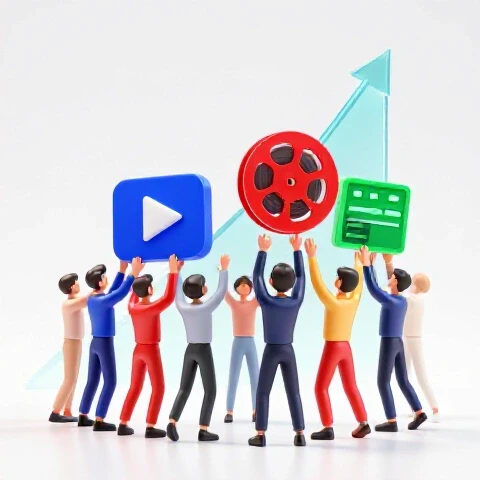
Building a YouTube team is about creating a machine. This machine needs fuel (your ideas), a motor (your team), and a manual (your systems). Without the manual, the motor breaks. Without the motor, the fuel just sits there. The goal of this guide is to help you write that manual and tune that motor so you can scale without the typical friction that stops most creators in their tracks.
Why is a Structured Approach Necessary for Growth?
A structured approach ensures that every video maintains a consistent level of quality regardless of who is behind the editing software. It prevents the “quality dip” that many creators fear when they first stop doing everything themselves. By having clear systems, you reduce the need for constant back-and-forth communication, which is often the silent killer of productivity in small media businesses.
Transitioning from Creator to Operator Roles
Transitioning into an operator role means your primary output is no longer the video itself, but the systems that produce the video. You spend your time reviewing metrics, refining strategies, and managing the people who execute the tasks. This allows for a scalable video creation process where adding more content doesn’t mean adding more stress to your personal life.
Identifying High-Impact Areas for Task Assignment
Selecting which duties to pass on first is critical for maintaining momentum and seeing immediate relief in your schedule. High-impact areas are typically those that are time-consuming, repetitive, and require a specific technical skill that others can replicate. Focus on tasks that follow a predictable pattern, as these are the easiest to document and hand over.
When I first started expanding my operations, I made the mistake of trying to delegate everything at once. I quickly learned that it is better to master the delegation of one area before moving to the next. The most common entry points for team-optimized video marketing are video editing, thumbnail design, and administrative channel management. These roles have clear boundaries and measurable outputs.
- Video Editing: This is usually the most time-intensive part of the process. Handing this off can save between 10 to 30 hours per video, depending on the complexity.
- Thumbnail and Graphic Design: Visuals are the “packaging” of your content. A dedicated designer can often produce higher-quality click-through-rate (CTR) drivers than a generalist creator.
- Administrative Tasks: This includes uploading, metadata optimization, and community management. These are routine tasks that follow a strict set of rules.
Which Tasks Should You Delegate First?
The best tasks to delegate first are those that you find draining or those that take the longest to complete. If you spend eight hours editing but only two hours Scripting, the editing is the clear candidate for delegation. Interestingly, the tasks you are “good at” but don’t enjoy are often the best ones to pass to a specialist who loves that specific craft.
Creating a Delegation Decision Matrix
A decision matrix helps you objectively decide what to keep and what to hand over. You can categorize tasks based on how much you enjoy them versus how much value they provide to the business. Tasks that are low-enjoyment but high-value are the primary targets for your new team members.
| Task Category | Level of Repetition | Technical Difficulty | Delegation Priority |
|---|---|---|---|
| Rough Cut Editing | High | Medium | Very High |
| Sound Design | High | Medium | High |
| Thumbnail Concepts | Low | High | Medium (Keep Strategy) |
| Metadata Entry | Very High | Low | Very High |
| Final Creative Review | Low | Medium | Low (Keep Control) |
Developing Standard Operating Procedures for Quality Control
Standard Operating Procedures (SOPs) are the written instructions that allow someone else to replicate your results. They are the backbone of any successful media business scaling effort, providing a roadmap for your team to follow. Without SOPs, you will find yourself answering the same questions repeatedly and correcting the same mistakes.
The truth about delegating YouTube tasks is that your team can only be as good as your instructions. I have seen many creators fail because they expected an editor to “just know” their style. Your style is actually a collection of specific choices: how long a cut lasts, what fonts you use, and how you transition between scenes. SOPs document these choices so they can be repeated.
- Step-by-Step Guides: Break down complex tasks into small, manageable actions.
- Visual Examples: Use screenshots or short screen-recording clips to show exactly what “good” looks like.
- Checklists: Provide a final “quality assurance” list that the team member must complete before submitting their work.
How to Create SOPs That Protect Your Voice
To protect your channel’s voice, your SOPs must include a “Style Guide” section. This defines the tone, the pacing, and the specific “no-go” areas for your content. For example, if you never use flashy transitions, your SOP should explicitly state: “Use only simple cross-fades or jump cuts; avoid all 3D transitions.” This level of detail ensures your brand remains intact.
The Anatomy of an Effective Production SOP
An effective SOP is not a massive manual that no one reads. It is a living document that is easy to search and follow. It should include the objective of the task, the tools required, a step-by-step workflow, and a troubleshooting section for common issues. Building this early in your YouTube business scaling journey saves hundreds of hours of revision time later.
| SOP Component | Purpose | Example Detail |
|---|---|---|
| Objective | Defines the goal | “Create a high-energy 10-minute edit.” |
| Style Assets | Ensures visual branding | Link to specific font files and color palettes. |
| Workflow Steps | The “How-To” | “1. Sync audio. 2. Cut dead air. 3. Add B-roll.” |
| Quality Checklist | Final verification | “Check for audio peaking. Verify all text is legible.” |
Managing the Production Pipeline with External Support
Managing a pipeline involves overseeing the movement of a video from the initial idea through to the final upload. When you have a team, this pipeline needs to be visible to everyone involved so that bottlenecks can be identified and cleared. It transforms the creative process from a series of random acts into a predictable manufacturing line.
In my experience, the most successful creators use a centralized system to track progress. You need to know exactly where a video is at any given time. Is it in the “Scripting” phase? Is the “Editor” waiting for more B-roll? A clear pipeline reduces the mental load of remembering every detail. As a result, you can manage multiple videos simultaneously without feeling overwhelmed.
- Centralized Tracking: Use a project management framework to see all active projects in one view.
- Clear Deadlines: Assign specific dates for each stage of the process, not just the final publish date.
- Communication Protocols: Define where and how the team should communicate to avoid scattered messages.
Building an Integrated Workflow for Video Creation
An integrated workflow connects the different roles in your team. For instance, once you finish filming, the system should automatically notify the editor that the files are ready. When the editor finishes the rough cut, the thumbnail designer should be notified to start their work based on the video’s actual content. This “hand-off” process is where most efficiency is gained or lost.
Handling Feedback and Revisions Efficiently
Feedback is a necessary part of the process, but it can become a time-sink. Instead of long emails, use time-stamped comments on video drafts. This allows the editor to see exactly which frame you are referring to. I recommend a “Two-Round Limit” for revisions: one round for major structural changes and a second for minor polishing. This keeps the project moving toward completion.
Maintaining Creative Integrity Through Collaborative Systems
Creative integrity is the feeling that your content still belongs to you and reflects your unique perspective. Many creators fear that hiring help will make their videos feel “corporate” or “soulless.” However, by building collaborative systems, you can actually enhance your creativity by surrounding yourself with specialists who bring new ideas to your framework.
The key to maintaining quality while building a YouTube team is the “Creative Review” phase. You don’t need to do the work, but you must be the final filter. By setting up a system where you approve the script, the rough cut, and the final thumbnail, you retain 100% of the creative control while only doing 10% of the manual labor.
- Feedback Loops: Regularly discuss what is working and what isn’t with your team.
- Creative Briefs: Provide a short document for every video that outlines the “vibe,” the main goal, and any specific requirements.
- Specialist Empowerment: Encourage your team to suggest improvements. An editor might find a better way to visualize a point than you originally planned.
How to Delegate Without Losing Your Channel’s “Soul”
Your channel’s soul often lives in the storytelling and the direct connection with the audience. Keep the tasks that involve your personal “voice”—like final script polishing or on-camera performance—and delegate the technical execution. This balance ensures the “soul” remains while the “body” of the work is handled by others.
Measuring Quality Retention Rates
You can track how well your team is maintaining your standards by looking at the “Revision-to-Output” ratio. If a new editor requires five rounds of revisions in month one but only one round by month three, your SOPs and training are working. This is a measurable way to see your scaling progress in action.
| Scaling Metric | Definition | Target Benchmark |
|---|---|---|
| Revision Ratio | Rounds of feedback per video | Under 2 rounds per project |
| On-Time Delivery | Percentage of tasks met by deadline | 95% or higher |
| SOP Compliance | Accuracy of following written guides | 100% on technical specs |
| Time Reallocation | Hours moved from production to strategy | 15+ hours per week |
Measuring the Success of Team-Based Video Operations
Measuring success goes beyond just counting the number of videos published. It involves looking at how the team has impacted your overall efficiency, the quality of the content, and your personal well-being. Success in a media business means you are achieving more with less personal effort, creating a sustainable path for long-term growth.
When I look back at my own transition, the most telling metric wasn’t the subscriber count, but the “Production Cycle Time.” This is the total time it takes for a video to go from an idea to being live on the channel. With a team, this cycle might actually take longer in calendar days (because of hand-offs), but it takes significantly less of your time.
- Output Volume: Are you able to produce more content or higher-quality content than before?
- Consistency: Is your upload schedule more predictable?
- Personal Bandwidth: Do you have time to research new topics, network, or rest?
Benchmarking Your Scaling Progress
As you move through the 6 to 24-month mark of building your team, you should see a clear shift in your metrics. Initially, your “Time Saved” might be low because you are busy training. However, after the first 90 days, the ROI of your team should become apparent. You should be spending the majority of your time on “Level 10” tasks—those that only you can do.
Workflow Efficiency: Initial Delegation vs. Optimized Team
The following table shows how production timelines change as you move from basic delegation to a fully optimized team system.
| Production Stage | Initial Delegation (Hours) | Optimized Team (Hours) | Efficiency Gain |
|---|---|---|---|
| Pre-Production | 4 hours | 2 hours | 50% |
| Video Editing | 12 hours | 1 hour (Review only) | 91% |
| Thumbnail Design | 3 hours | 0.5 hours (Review) | 83% |
| Upload & Admin | 2 hours | 0 hours | 100% |
| Total Personal Time | 21 hours | 3.5 hours | 83% Reduction |
Long-Term Business Optimization and Sustainability
Sustainability in the creator economy means building a business that doesn’t burn you out. Long-term optimization involves refining your team structure and your systems so they can handle fluctuations in the market or your personal life. It is about moving from a “growth at all costs” mindset to a “growth through efficiency” mindset.
The final stage of transitioning from a solopreneur to a media business is the ability to step away. A truly scalable video creation business can function for a week or two without the owner’s constant input. This is achieved by hiring people who are better than you at their specific tasks and giving them the autonomy to succeed within your established systems.
- Continuous Improvement: Regularly update your SOPs based on new platform trends or team feedback.
- Role Evolution: As your team grows, your original “Editor” might become a “Post-Production Manager” who oversees other editors.
- System Redundancy: Ensure that more than one person knows how to perform critical tasks so the business doesn’t stop if someone is sick.
The 12-Month Scaling Roadmap
In the first three months, focus on documenting your process and hiring your first editor. Months four through eight should be dedicated to refining your communication and adding a second role, like a designer or assistant. By month twelve, your goal is to have a “Production Rhythm” where you only intervene at key creative checkpoints.
Final Thoughts on the Operator Mindset
Building an efficient production team is a journey of small, consistent improvements. It requires patience, as the first few weeks of delegating YouTube tasks often feel like more work than doing it yourself. However, the reward is a business that serves you, rather than you serving the business. You regain your creative spark because you are no longer bogged down by the mechanics of production.
FAQ: Navigating the Realities of Team Delegation
How do I know if I am ready to start building a team? You are ready when your production schedule is full and you are turning down opportunities or sacrificing content quality because of time constraints. If you have a proven content format and a consistent workflow that produces results, you have something that can be taught to others.
Will my audience notice if I stop editing my own videos? If you use detailed SOPs and a solid style guide, the audience should only notice an improvement in quality. Most creators find that a professional editor can actually enhance their “vibe” by adding polish that the creator didn’t have the time or technical skill to implement.
How do I find the right people to join my media business? Look for specialists who have a portfolio that matches your desired style. Instead of a generalist, hire a “YouTube Editor” who understands pacing and retention. Always start with a small, paid test project to see how well they follow your current instructions and how they handle feedback.
What is the most common mistake when delegating YouTube tasks? The most common mistake is “delegation by abdication”—handing over a task and disappearing. You must remain involved as a manager. Delegation is a partnership where you provide the vision and the system, and they provide the execution.
How much time should I expect to spend managing my team? Initially, you might spend 5-10 hours a week on management and training. Once your systems are optimized and your team is experienced, this should drop to 2-4 hours a week for a standard production schedule.
What if an editor’s style doesn’t perfectly match mine at first? This is normal. Use the first three to five videos as a “calibration period.” Provide very specific, timestamped feedback. If you find yourself giving the same feedback twice, update your SOP to ensure the mistake doesn’t happen a third time.
How do I handle the fear of someone “stealing” my channel’s secrets? Your “secret” isn’t a specific editing trick; it’s your unique perspective and your relationship with your audience. By using non-disclosure agreements and keeping the highest-level strategy to yourself, you protect your business while empowering your team to handle the manual labor.
Do I need a manager to oversee the team? Not at first. You should be the manager until you have 3-4 team members. At that point, you can promote your most reliable team member to a “Lead” or “Producer” role to handle the daily coordination, further reducing your workload.
What tools are essential for a remote production team? You need three types of tools: a place to store and share large video files, a project management system to track task status, and a communication platform for quick questions and updates. Avoid using email for project-specific feedback as it gets lost too easily.
How do I maintain consistency across multiple team members? Consistency comes from centralized assets. All team members should have access to the same “Brand Kit,” including fonts, color codes, music libraries, and motion graphics. When everyone uses the same ingredients, the final product remains consistent.
Can I delegate the creative brainstorming process? You can delegate the research and data collection, but you should stay heavily involved in the final creative decisions. A team member can find five trending topics, but you should be the one to decide which one fits your voice and brand strategy.
How do I transition if I’ve always done everything myself? Start small. Delegate the most repetitive, non-creative task first, such as generating subtitles or creating basic social media clips from your long-form content. This builds your “delegation muscle” without the high stakes of a full video edit.
(This article was written by one of our staff writers, Christopher Lang. Visit our Meet the Team page to learn more about the author and their expertise.)