Switching From Quantity to Quality Content on YouTube (Case Study)
I remember sitting in my home office at 2:00 AM, staring at a half-finished edit for a video I didn’t even care about. I had committed to a three-video-a-week schedule because every “expert” told me that volume was the only way to feed the algorithm. My channel was sitting at 8,000 subscribers, but my growth had flatlined. I was exhausted, my content felt thin, and I was dangerously close to quitting. Mentioning ease of care might seem strange when talking about a high-effort platform like YouTube, but that night, I realized my current pace was the opposite of easy. It was unsustainable.
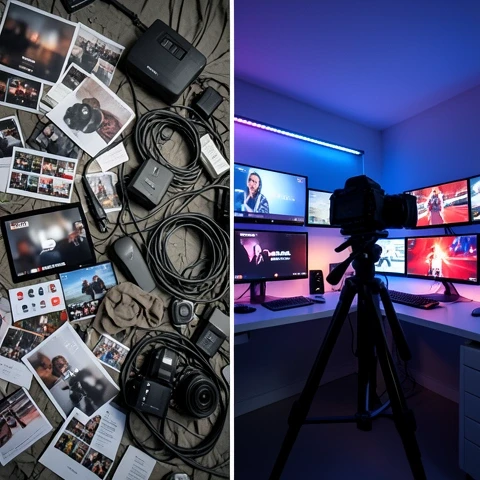
I decided to run an experiment on my own channel. I stopped the assembly line and shifted my focus from quantity to quality. I went from twelve videos a month down to just two. This YouTube growth guide documents exactly what happened to my analytics, my audience, and my mental health during that transition. It is a raw look at my channel growth diary over an eighteen-month period.
The Breaking Point: Why I Stopped Chasing the Upload Calendar
The breaking point is the moment a creator realizes that their current output volume is producing diminishing returns for their channel growth. It is characterized by high stress, stagnant view counts, and a feeling that you are a slave to the “Publish” button.
For the first three years of my journey, I believed that more was always better. I was obsessed with my upload frequency. I thought that if I just threw enough darts at the wall, one of them would eventually stick. By the time I reached 10,000 subscribers, I had uploaded over 250 videos. However, my average view duration was plummeting. People were clicking, but they weren’t staying.
I looked at my data and saw a painful trend. My videos were getting “hustle views”—a small spike in the first 48 hours followed by a flat line that never moved again. I was working 60 hours a week on top of my day job, yet my channel felt like it was on life support. I realized that I wasn’t building an asset; I was running a treadmill. I decided to pivot. I chose to prioritize the depth of my content over the frequency of my posts.
My 3-Video-a-Week Burnout Phase
In this phase, I was focused on “good enough” content. I would spend about five hours on a video from start to finish. This included two hours of filming, two hours of editing, and one hour for the thumbnail and title. I was hitting my deadlines, but I was sacrificing the soul of the channel.
- My research was surface-level.
- My storytelling lacked a clear hook or emotional payoff.
- My thumbnails were repetitive and lacked visual hierarchy.
- I was ignoring my analytics because I was too busy making the next video.
Defining Quality vs. Quantity in My Personal Workflow
Quality is not just about having a 4K camera or expensive lighting. In my experience, quality is the measure of how much value, clarity, and engagement a video provides to the viewer per minute of watch time.
When I shifted to a quality-first approach, I redefined what a “finished” video looked like. I stopped measuring success by the number of uploads and started measuring it by “Retention Benchmarks.” I began spending thirty to forty hours on a single video instead of five. This meant deeper research, scripted storytelling, and intentional editing.
I found that quality content requires a different mental framework. You have to be willing to kill your darlings. If a scene didn’t serve the narrative, I cut it, even if it took three hours to film. This shift changed my channel from a news-style feed into a library of evergreen resources.
The Shift in My Pre-Production Metrics
I started spending 50% of my total production time in the “Pre-Production” phase. Before I ever turned on the camera, I had to prove to myself that the video was worth making. I developed a checklist that every video had to pass.
- Does the title promise a specific transformation or answer?
- Is the thumbnail understandable in less than two seconds?
- Does the first 30 seconds of the script address the viewer’s primary pain point?
- Is there a unique data point or personal story that no one else can tell?
How My Analytics Responded to the Quality Pivot
The most terrifying part of this shift was the initial silence. When I stopped posting three times a week, my total monthly views actually dropped for the first sixty days. I panicked. I thought I had killed the channel. But then, something interesting happened. My “Suggested Video” traffic began to climb.
YouTube’s algorithm started to recognize that when people clicked on my new, high-quality videos, they stayed until the end. Because my Average View Duration (AVD) jumped from 30% to 55%, the platform felt more confident recommending my content to new audiences. My “Impressions” began to scale vertically rather than horizontally.
Below is a comparison of my channel metrics during the “Quantity Phase” versus the “Quality Phase.”
| Metric | Quantity Phase (12 videos/mo) | Quality Phase (2 videos/mo) |
|---|---|---|
| Average View Duration | 2:15 (31%) | 6:45 (58%) |
| Click-Through Rate (CTR) | 3.4% | 8.2% |
| New Subscribers per 1k Views | 12 | 45 |
| Returning Viewers | 15% | 42% |
| Production Time per Video | 5 Hours | 35 Hours |
| Monthly View Growth | Flat (+2%) | Compounding (+15%) |
The Retention Curve Transformation
In my quantity phase, my retention curves looked like a steep cliff. There was a massive drop-off in the first 30 seconds, followed by a steady decline. I was losing 50% of my audience before I even got to the main point of the video.
After the switch, my retention curves leveled out. By focusing on a “Hook, Meat, and Payoff” structure, I kept viewers engaged. I learned that a high-quality video doesn’t just have better information; it has better pacing. I started using “pattern interrupts”—visual or auditory changes every 60 to 90 seconds—to keep the viewer’s brain active. This single change was the primary driver for my channel hitting the 30,000-subscriber milestone.
The Impact on My Audience Engagement and Community
A significant benefit of quality over quantity was the change in the “type” of subscriber I was attracting. When I posted frequently, I had “passive” subscribers. They might watch a video if it showed up on their home page, but they weren’t seeking me out.
Once I started producing deep-dive, high-value content, my community became “active.” The comments moved from “Great video!” to long, thoughtful paragraphs about how the content helped them. I noticed that my “Shares” metric exploded. People don’t usually share “good enough” content; they share content that makes them look smart or provides a solution to a friend’s problem.
Quality Over Quantity in the Comment Section
I found that I had more energy to engage with my audience when I wasn’t filming every day. Because I only had two comment sections to manage per month instead of twelve, I could provide detailed responses. This created a feedback loop. My viewers felt heard, which led to higher loyalty and a higher “Returning Viewer” rate in my analytics.
- I responded to 90% of comments in the first 24 hours.
- I used community polls to let my audience vote on the next “deep-dive” topic.
- I noticed a 300% increase in “Super Thanks” and community engagement.
Sustainable Growth vs. Viral Spikes: My Long-Term Findings
Many creators chase virality, but I found that quality leads to sustainability. A viral video is often a fluke of the algorithm. A high-quality video is a predictable asset. My quality videos continued to gain views months and even years after they were posted.
I tracked the “decay rate” of my videos. My quantity-focused videos usually stopped getting views after 14 days. My quality-focused videos had a “half-life” of over 180 days. This meant that even when I took a week off for family or a vacation, my channel continued to grow. This is what I mean by sustainable YouTube growth.
The Compounding Effect of “Evergreen Quality”
I realized that every high-quality video I added to my channel was like a new employee working for me 24/7. Because the content was researched and well-produced, it didn’t become obsolete.
- Video A (Quantity): “YouTube News Update Oct 2020” – Views stopped after 1 week.
- Video B (Quality): “The Psychology of Viral Thumbnails” – Still gets 500 views a day two years later.
By focusing on evergreen topics with high production value, I built a library that grows on its own. This allowed me to break the 50,000-subscriber barrier without increasing my workload.
Lessons Learned: Managing the Mental Shift
The hardest part of switching from quantity to quality wasn’t the editing; it was the guilt. I felt like I was “lazy” because I wasn’t uploading every Tuesday and Friday. I had to retrain my brain to value the outcome over the output.
I also had to learn to deal with the “Quality Trap”—the fear that a video won’t perform well after I spent 40 hours on it. I learned that even if a high-quality video “flops” initially, its long-term potential is still 10x higher than a rushed video. I started looking at my channel in 90-day windows instead of 24-hour windows.
My Personal Action Plan for Scaling Quality
If I were to start this pivot again, I would follow a specific sequence to avoid the “silence” that happens when you stop posting frequently.
- Audit your current library: Identify which 20% of your videos are driving 80% of your watch time. These are your “quality” indicators.
- Batch your research: Spend one full week just researching and scripting two high-level videos.
- Increase your “B-Roll” ratio: Use more visual aids and less “talking head” footage to keep retention high.
- Focus on the “First 30”: Spend 25% of your editing time on the first 30 seconds of the video.
- Analyze the “Dips”: Look at your retention graphs in YouTube Studio and find exactly where people leave. Cut those parts out of your next script.
The Tools and Resources That Supported My Shift
To make this transition, I had to change how I organized my life. I couldn’t just “wing it” anymore. I needed systems that supported deep work and long-form creation.
- Project Management: I moved my entire production calendar into a dedicated tracker. This allowed me to see the progress of a video from the “Idea” stage to “Final Export.”
- Scripting Software: I switched from basic notes to a structured script format that included visual cues and pacing notes.
- Analytics Tracking: I maintained a spreadsheet where I tracked my 30-day retention and CTR for every new upload.
- Feedback Loops: I started showing my rough cuts to a small group of fellow creators to find “boring” spots before I published.
- Stock Assets: I invested in high-quality sound effects and B-roll libraries to increase the “perceived value” of my videos without needing a Hollywood budget.
Final Reflections on the Quality Pivot
Looking back at my journey from 0 to 50,000 subscribers, the shift to quality was the single most important decision I made. It saved me from burnout and allowed me to build a channel that I am actually proud of. I no longer feel the pressure to “feed the beast.” Instead, I focus on creating the best possible resource for my audience.
The “Ease of Care” I mentioned at the beginning came from trust. I trust that if I put in the work to make a great video, the algorithm will eventually find the right audience for it. I don’t have to scream for attention anymore; the quality of the work speaks for itself.
Key Takeaways from My Experience
- AVD is King: High quality leads to higher Average View Duration, which is the primary signal for the algorithm to push your content.
- Burnout is a Metric: If you are too tired to be creative, your content quality will suffer, and your growth will stall.
- Evergreen Assets: One high-quality video is worth more than twenty “news-style” videos in the long run.
- Audience Loyalty: Quality builds a community; quantity builds a temporary following.
- The 90-Day View: Judge your success by quarterly growth, not daily view counts.
FAQ: What Happened After I Switched From Quantity to Quality Content
Did your views drop immediately after you stopped posting frequently?
Yes, my total monthly views dropped by about 20% in the first two months. This happened because I was no longer getting the “initial spike” from frequent uploads. However, after about 90 days, my views surpassed my previous records because my high-quality videos began to get picked up by the “Suggested” and “Browse” features. The long-tail traffic from quality content far outweighed the short-term spikes from quantity.
How did you decide which topics were “quality-worthy”?
I looked at my past analytics to see which videos had the highest “Subscribers Gained” per 1,000 views. This told me which topics resonated most deeply with my audience. I also looked for “Evergreen” potential—questions that people would still be asking five years from now. If a topic was only relevant for a week, I stopped making videos about it.
Did you need to buy new equipment to improve your quality?
Actually, no. Most of my quality improvements came from better scripting and editing. I learned that viewers will forgive average video quality if the storytelling is tight and the information is valuable. I focused on lighting I already had and used a cheap lavalier microphone. The “quality” was in the preparation, not the pixels.
How did you handle the pressure to upload when a video wasn’t ready?
This was the hardest part. I had to learn to be okay with missing a “deadline” if the video wasn’t up to my new standards. I realized that my audience would rather wait an extra week for a great video than get a mediocre one on time. I communicated this shift to my community, and they were incredibly supportive.
What was the most surprising metric that improved?
The “Returning Viewers” metric in YouTube Studio. Before the shift, most of my viewers were “one-and-done.” After the shift, I saw a massive increase in people coming back to the channel every time I posted. This created a much more stable and predictable growth pattern.
How did your production time change?
It went from about 5-6 hours per video to nearly 40 hours. While that sounds like more work, I was only doing it twice a month. This meant I was working 80 hours a month on videos instead of 70+ hours a month on a rushed schedule. The work was more intense, but it was less frequent, which prevented the “always-on” burnout feeling.
Did the algorithm “punish” you for not uploading weekly?
In my experience, no. The idea that you must upload every week to stay in the algorithm’s good graces is a myth for most niches. YouTube cares about how viewers respond to the videos you do upload. When my engagement metrics (CTR and AVD) went up, the algorithm rewarded me with more impressions, regardless of my upload frequency.
Is this strategy right for every niche?
While I can only speak to my experience in educational and storytelling niches, I believe the principle applies broadly. However, news-based or trending-topic channels might still need a higher volume. For creators building a personal brand or an evergreen library, quality is almost always the better long-term play.
How did you stay motivated during the slow periods?
I shifted my focus from “Views” to “Retention.” Even if a video only had 1,000 views, if the retention was 60%, I considered it a massive win. I started gamifying my own analytics, trying to beat my previous “Best Retention” record. This kept me focused on the craft rather than the vanity metrics.
What is the first step a creator should take to make this switch?
Start by doubling your production time on your next video. If you usually spend four hours, spend eight. Use those extra four hours specifically on the script and the first 60 seconds of the edit. Don’t worry about changing your whole schedule yet—just see what happens when you give one video 100% of your creative energy.
(This article was written by one of our staff writers, Michael Hale. Visit our Meet the Team page to learn more about the author and their expertise.)