How to Upgrade Your YouTube SOPs for Scalable Video Production (Guide)
Highlighting trends in the creator economy shows a clear divide between those who burn out and those who build a legacy. After 11 years of scaling YouTube channels, I have learned that the difference lies in the systems you build. When I started, my “system” was just a messy collection of mental notes and frantic late-night editing sessions. Today, that has evolved into a structured media business where my team handles the heavy lifting, allowing me to focus on high-level strategy.
The transition from a solo creator to a business operator is often messy. You might feel that no one can edit quite like you do or that explaining your process takes longer than just doing the work yourself. I felt the same way until I hit a wall where I could no longer grow without help. By comparing my early, informal workflows with the documented systems I use now, we can see exactly how a structured approach changes the outcome of every video you produce.
Analyzing the Evolution of Video Production Workflows
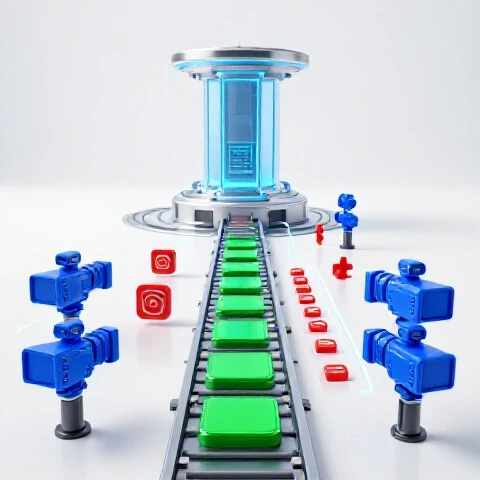
Standard operating procedures (SOPs) are documented instructions that turn creative tasks into repeatable business processes. Comparing early solo efforts to mature team systems reveals how documentation reduces errors and speeds up production while maintaining quality across different roles. This evolution allows a creator to step back from daily tasks without the quality of the content suffering.
In the beginning, my production process was reactive. I would wake up, decide on a topic, and start filming. There was no checklist for lighting, no script structure, and certainly no plan for promotion. This led to inconsistent quality and a constant feeling of being behind. My current system, however, is proactive. It breaks down every video into distinct phases: research, scripting, filming, editing, and distribution.
Each phase has its own dedicated SOP. For example, my current scripting SOP includes a “Hook Audit” where we check the first 30 seconds against successful past videos. My early self never did this. By documenting these small but vital steps, I ensured that my team could replicate my successes without me needing to be in the room.
The most significant change was moving from a single “to-do” list to a multi-stage project management system. I now use Notion to track every video’s progress through a pipeline. This visibility is what allows me to manage multiple channels simultaneously. Without these documented pathways, I would still be stuck in the weeds of daily production.
How to Create SOPs That Let You Delegate Video Editing Without Losing Your Channel’s Voice
A voice-preserving SOP captures the nuances of your style, including pacing, humor, and visual cues. By moving from vague instructions to detailed style guides, you ensure that hired editors can replicate your unique creative fingerprint without constant oversight or revisions. This creates a seamless transition where the audience cannot tell that a team is now involved.
When I hired my first editor, I made a classic mistake. I simply sent them a raw file and said, “Make it look like my other videos.” The result was a disaster. The pacing was off, and the jokes didn’t land. I realized that my “voice” was actually a set of specific editing choices I had never written down.
To fix this, I created a Style Guide SOP. This document doesn’t just say “be funny.” It specifies which sound effects to use for certain types of jokes, the exact font and hex codes for on-screen text, and the maximum length for any single B-roll clip. We also built a “B-roll Library” categorized by emotion and topic, so the editor doesn’t have to guess what visuals I prefer.
- Pacing Rules: No more than three seconds of a talking head without a visual cut or zoom.
- Audio Standards: Music must dip to -25db when the host is speaking.
- Color Grading: Use the custom LUT provided in the brand folder for all A-roll.
- Feedback Loop: Use Frame.io for time-stamped comments to reduce back-and-forth emails.
By providing these specific constraints, I actually gave my editor more freedom to be creative within the brand’s boundaries. The outcome was a video that felt like “me” but was produced in half the time it used to take.
Comparing Solo vs. Team-Based Production Timelines and Costs
Production timelines measure the total hours spent from ideation to upload. Analyzing the shift from solo to team-based workflows highlights how delegating specific tasks reduces the creator’s active involvement, allowing for a higher volume of content without a corresponding increase in personal effort. This data proves that systems are an investment, not just an expense.
When I worked alone, a single high-quality video took me roughly 32 hours to produce from start to finish. This included everything from thumbnail design to responding to comments. Today, my personal time investment per video is down to about 4 hours. The rest is handled by my team, guided by the SOPs we developed together.
| Production Phase | Solo Creator Time (Hours) | Team-Based Time (Creator Input) | Team-Based Time (Staff Input) |
|---|---|---|---|
| Research & Ideation | 4 | 1 | 3 |
| Scripting & Outline | 6 | 1 | 5 |
| Filming / Recording | 4 | 2 | 0 |
| Video Editing | 12 | 0 | 12 |
| Thumbnail & Title | 3 | 0 | 3 |
| Upload & SEO | 2 | 0 | 2 |
| Community Management | 1 | 0 | 1 |
| Total Hours | 32 | 4 | 26 |
Interestingly, while the total man-hours increased slightly (to 30 hours), my personal involvement dropped by 87%. This is the “scaling multiplier.” By spending four hours on the high-leverage tasks—strategy and filming—I can now oversee the production of four videos in the same time it used to take me to make one.
The financial outcome is equally compelling. If my time is worth $100 an hour, a solo video “cost” me $3,200 in opportunity cost. By hiring an editor and an assistant at a combined rate of $40 an hour, the cash cost is $1,040, plus my $400 of time. I am saving $1,760 per video while increasing my output capacity.
Building a YouTube Team: Role Prioritization and Hiring Strategies
Role prioritization involves identifying which tasks consume the most time but require the least amount of your specific creative input. Hiring based on these priorities ensures that your first team members provide the maximum relief from daily operational burdens, facilitating smoother scaling. This prevents the common mistake of hiring for the wrong role too early.
Most creators think they need a manager first, but they actually need a specialist. I recommend the “Bottom-Up” hiring strategy. Look at your time logs and identify the task you hate the most or the one that takes the longest. For 90% of YouTube creators, this is video editing.
- The Video Editor: This is your first hire. They handle the technical assembly of your story.
- The Thumbnail Designer: A specialist who understands click-through rates (CTR) and visual hierarchy.
- The Virtual Assistant (VA): They handle the “friction” tasks like uploading, adding end screens, and organizing files.
- The Writer/Researcher: Once your production is smooth, you hire someone to help sharpen your ideas.
When hiring, I look for “SOP-First” thinkers. During the interview, I ask candidates to describe a process they improved in a previous job. If they can’t explain a workflow, they will likely struggle to follow yours. I also use a paid test project for every hire. I provide a raw clip and a basic SOP to see how well they follow instructions and if they can capture the channel’s tone.
Building a team is not about finding a “mini-me.” It is about finding people who are better than you at specific parts of the process. My current editor is a much faster and more creative cutter than I ever was. My designer understands color theory better than I do. By delegating, I didn’t just save time; I improved the quality of the final product.
Quality Control and Workflow Integration for Scalable Content
Quality control systems are the checkpoints that ensure every piece of content meets your brand standards before it goes live. Integrating these into your workflow prevents the “delegation trap” where you spend more time fixing mistakes than you would have spent doing the work yourself. Effective systems make excellence the default outcome.
One of my biggest instructive failures was delegating my thumbnail design without a quality control (QC) process. I woke up to find a video had been live for six hours with a thumbnail that had a typo. It was a painful lesson in the necessity of checkpoints. Now, no video or thumbnail is published without passing a “Final Review” checklist.
Our current QC workflow is built directly into our project management tool. Before an editor can mark a task as “Done,” they must check off a series of boxes: * Are all transitions smooth? * Is the background music volume consistent? * Have all “um” and “ah” sounds been removed? * Are there any frame-rate glitches?
As the business owner, I only step in at the “Creative Approval” stage. I look at the final cut to ensure the story flows well. I don’t look for technical errors because the SOP has already filtered those out. This separation of technical QC and creative approval is vital for scaling. It allows you to stay in the “Director” role rather than the “Quality Inspector” role.
Measurable Outcomes of Moving from Solopreneur to Media Business Operator
Success in scaling is measured by changes in output, engagement, and personal freedom. Tracking these metrics before and after implementing team-driven workflows shows the real-world impact of systems on revenue growth, upload frequency, and the long-term sustainability of the channel. These numbers provide the confidence needed to keep investing in your team.
The most immediate outcome I noticed after implementing these systems was consistency. As a solo creator, if I got sick or took a vacation, my channel died. With a team and SOPs, the channel keeps moving regardless of my personal schedule. In one case study of a channel I helped scale, we saw the following results over a 12-month period:
- Upload Frequency: Increased from 1 video per week to 3 videos per week.
- Average View Duration (AVD): Rose by 14% due to professional editing and better pacing.
- Monthly Revenue: Increased by 210% as a result of higher volume and better quality.
- Creator Burnout Score: Dropped significantly (measured by self-reported stress levels).
Building a media business also increases the “asset value” of your channel. A channel that relies entirely on one person’s manual labor is a job. A channel that runs on systems and a team is a business that can eventually be sold or managed by others. This shift in mindset from “content creator” to “business owner” is the ultimate goal of scaling.
Financial Scaling and the ROI of Team-Based Production
Financial scaling involves managing the cost of a team against the increased revenue generated by higher output and better quality. A sustainable business model balances these expenses to ensure that the transition from a solo creator to an operator remains profitable and scalable over time. You must treat your team as a profit center, not a cost center.
Many creators hesitate to hire because they see it as losing money. However, you have to look at the Return on Investment (ROI). If hiring an editor costs you $1,500 a month but allows you to produce four extra videos that generate $4,000 in additional ad sense and brand deals, that hire has a 166% ROI.
I track my “Team Efficiency Ratio” monthly. This is the total revenue divided by the total team cost. In the early stages of scaling, this ratio might dip as you spend time training. However, within 6 months, you should see it stabilize and then grow. If the ratio stays low, it usually means your SOPs are not efficient enough or you are over-staffed for your current revenue.
- Phase 1 (0-6 months): High training costs, lower efficiency. Focus on SOP clarity.
- Phase 2 (6-12 months): Systems stabilize. Output increases. Revenue begins to outpace costs.
- Phase 3 (12+ months): The “Flywheel” effect. The team operates autonomously, and you focus on new revenue streams.
By the time you reach Phase 3, you are no longer just making videos; you are running a media company. You have the time to negotiate better brand deals, launch products, or even start a second channel. This is only possible because you moved your processes out of your head and into a system that others can execute.
Conclusion: Your Roadmap to Scalable Production
Transitioning from a solo creator to a media business operator is the most rewarding move you can make. It starts with a simple audit of your current tasks and the creation of your very first SOP. Don’t try to document everything at once. Start with the one task that drains you the most.
As you build your team, remember that your role is to provide the vision and the systems, while they provide the execution. Compare your progress not to other creators, but to your own past workflows. Are you more consistent? Is your stress lower? Is your quality higher? If the answer is yes, you are on the right path.
The goal is to build a business that serves your life, rather than a life that serves your business. With documented systems and a trusted team, you can finally step away from the editing software and start thinking like the CEO your channel deserves.
FAQ: Scaling Your YouTube Production with SOPs
How do I know if I am ready to hire my first team member? You are ready when your growth is limited by your time rather than your ideas. If you have a backlog of video concepts but no time to produce them, or if you are consistently missing upload deadlines, it is time to delegate. Financially, you should have at least three to six months of “hire runway” saved up to cover the training period.
Won’t my viewers notice if I stop editing my own videos? If you use a detailed Style Guide SOP, the transition should be invisible. Your viewers care about the value and the “vibe” of the content, not who physically moved the clips on a timeline. In fact, most creators find that their AVD increases after hiring a professional editor because the technical quality improves.
How long does it take to create a good SOP? A basic SOP can be created in the time it takes to do the task once. Use a screen recorder like Loom to film yourself performing the task, then have a VA transcribe those steps into a written document. Refining the SOP will take a few production cycles as you and your team find better ways to work.
What is the biggest mistake creators make when building a team? The biggest mistake is “abdication instead of delegation.” This happens when a creator hands over a task without any systems or oversight and expects it to be done perfectly. You must stay involved in the quality control process until the SOP is proven to work consistently.
How do I handle creative differences with my new editor? Frame it as a system update rather than a personal critique. If an editor makes a choice you don’t like, ask yourself: “Is there a rule I can add to the SOP to prevent this?” This keeps the conversation professional and ensures the mistake doesn’t happen again.
Do I need expensive software to manage my team’s workflow? No. You can start with free tools like Google Docs and Trello. As you scale, you might move to more robust systems like Notion or ClickUp. The tool is less important than the clarity of the instructions inside it.
Should I hire a freelancer or a full-time employee? Start with freelancers or part-time contractors. This allows you to test the relationship and the workflow without the overhead of a full-time salary. As your production volume becomes predictable, you can transition your best contractors to more permanent roles.
How do I protect my channel’s security when hiring? Never give out your primary Google password. Use the “Permissions” feature in YouTube Studio to give team members “Editor” or “Manager” access. For other tools, use a password manager like LastPass or 1Password to share access securely without revealing the actual password.
What if my revenue isn’t high enough to afford a team yet? Look for “micro-delegation” opportunities. Can you hire a thumbnail designer for $30 a video? That might save you 3 hours that you can use to film more content or improve your scripts. Small investments in systems often lead to the growth needed to afford larger hires.
How do I keep my team motivated and aligned with my vision? Share your wins with them. If a video they worked on performs well or gets a great comment, tell them. Make them feel like partners in the channel’s success rather than just “hired hands.” A team that understands the “why” behind the SOPs will always perform better.
(This article was written by one of our staff writers, Christopher Lang. Visit our Meet the Team page to learn more about the author and their expertise.)